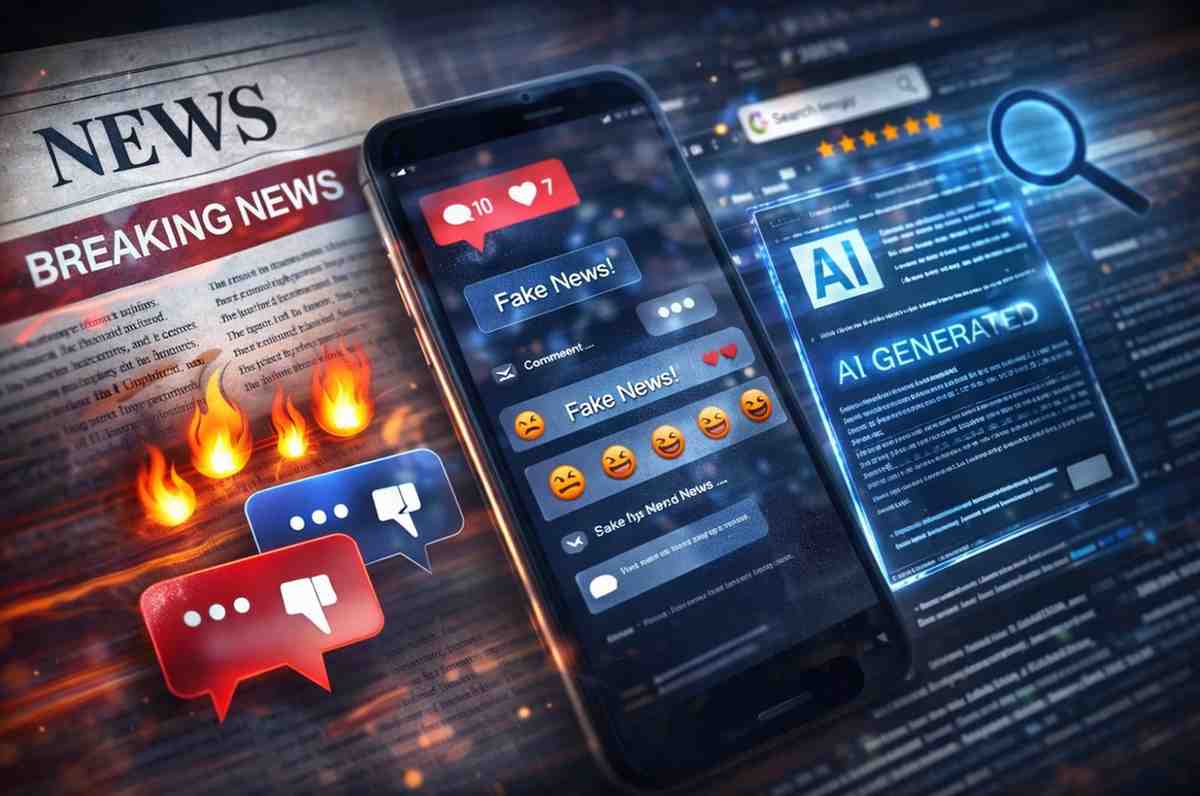
Deepfakes, fake reviews, and false claims are three of the fastest-growing threats to Chicago businesses in 2026. They are hitting restaurants, hospitality brands, and small businesses right now, planted by competitors, extortionists, disgruntled ex-employees, and anonymous bad actors. This guide, from Kurman Communications, a public relations agency in Chicago that has been protecting local brands since 1983, explains what these attacks look like, what to do about them, and how effective PR contains the damage.
What are deepfakes, fake reviews, and false claims, and why treat them as one problem?
They are three different attacks with one shared target: your reputation.
- Deepfakes. AI-generated video, audio, or images used to damage a business. That includes fabricated clips of your food looking spoiled, a “hidden camera” video staged inside a copy of your storefront, a fake voice recording of your owner, or a manipulated clip of a server behaving badly. The target can be your product, your service, your staff, or the person at the top. All of it works the same way: it looks real enough to spread before it can be disproven.
- Fake reviews. Fabricated negative reviews posted about your business on Google, Yelp, and TripAdvisor by people who were never customers. Often AI-generated, often part of coordinated attacks.
- False claims. Misinformation about your business spread through social media, blogs, or news, sometimes picked up by mainstream outlets before anyone verifies it.
Treat them as one problem because they do the same thing. They break the story customers tell themselves about your business. The response is not three separate playbooks. It is one integrated communications plan, and it belongs in your business the same way a fire evacuation plan does.
How real is this threat for Chicago businesses in 2026?
Real enough that the Illinois Restaurant Association has already flagged it. Its CEO, Sam Toia, has publicly noted an uptick in review bombings against mid- to upscale Chicago restaurants in the second half of 2025. We watched three of them unfold in real time in our own city:
- Alpana, Gold Coast. Fifty one-star Google reviews inside a few hours in November 2025. Rating dropped from 4.5 to 4.1. One of the fake reviewers asked owner Alpana Singh to contact him on WhatsApp to negotiate removal.
- SHŌ, Old Town. At least twenty fake reviews inside three to four hours on November 1, 2025. Rating fell from 4.9 to 3.0 overnight.
- Protein Bar & Kitchen. A Chicago-based chain with fourteen locations hit with cascading fake reviews starting on Halloween 2025.
Nationally, U.S. corporate losses from deepfake fraud reached roughly $1.1 billion in 2025, and only about a third of executives say their company is prepared. Public relations in Chicago now includes a category of work that did not meaningfully exist five years ago. Every business with a public-facing owner is in scope.
How do you spot a fake review or a deepfake attack early?
Detection is not perfect, but the patterns are learnable.
Signs you are being hit with fake reviews
- Multiple one-star reviews arriving in the same short window, often overnight or on a holiday
- Generic language that could describe any business, such as “terrible experience” or “worst place ever”
- Reviewer accounts with no history, or ones that jump between unrelated cities.
- Complaints that do not match your actual menu, service, or offering, and reviewer names you cannot find in any reservation or transaction record
- A direct message on WhatsApp, email, or Instagram shortly after, demanding money or gift cards to make the reviews stop
Signs a deepfake video, image, or audio may be circulating
- A video of your product, food, or premises that you do not recognize filming, especially one going viral quickly
- Footage that seems to show your staff or owner saying or doing something out of character
- Small visual mismatches: wrong logo placement, wrong uniform, wrong interior details, lighting or shadows that do not match
- Audio where lip movement is slightly out of sync, or where the voice sounds close but not quite right
- An urgent call or message from someone who sounds like a senior person in your business, pressuring you toward money, credentials, or secrecy
- The clip surfaces alongside a message demanding payment to take it down
If two or more of these show up together, treat it as an attack until proven otherwise.
What should your business do in the first 24 hours?
The first day decides the shape of the story. Most reputational damage in any incident lands inside twenty-four hours. Work in this order.
- Stop and verify. Do not respond, pay, or authorize anything until you have confirmed what you are dealing with. Screenshot every review, message, and demand before anything can be deleted.
- Do not pay an extortionist. Payment does not stop attacks; it invites more. Google and Yelp are explicit on this.
- Report through the right channel. Google’s Merchant Extortion form now handles review bombing cases and often removes fake reviews within days. Yelp has similar routes.
- Respond publicly, calmly, and once. Silence looks like admission. Post a short, factual reply that does not accuse anyone, notes no record of the described experience, and invites contact through your official channel.
- Brief your team and your community. Staff, partners, industry groups, and local journalists should hear from you before they hear from someone else.
- Bring in your PR partner. This is the point where an experienced firm earns its keep. Not to spin, but to sequence the response, prepare the spokesperson, and manage the phones so you can keep running the business.
Businesses that come out of these attacks well are the ones that had a plan written down before anything went wrong.
What effective public relations does when your brand is under attack
Detection and takedowns only go so far. The real work of containing one of these attacks is communications work. Done well, it does five things.
- Sets the counter-narrative fast. A short, credible statement from the business, placed with the right journalists, gets ahead of the fake version before it hardens into “the story.”
- Uses relationships, not press releases. Reporters at the Chicago Tribune, Block Club Chicago, Crain’s Chicago Business, and local TV take a call from a firm they know. A cold email during a crisis lands at the bottom of the pile. Public relations in Chicago has always been a relationship business, and never more than now.
- Activates the community layer. Industry bodies like the Illinois Restaurant Association, neighborhood chambers, and long-standing partners can vouch for a brand in ways it cannot vouch for itself. Third-party voices carry weight that self-defense never will.
- Protects the brand story. Lee Barrie, our Senior Vice President, has written that the priority in any brand crisis is not to over-hype the response, because reporters sense it and pull away. Steady, factual communication holds credibility. Loud, defensive communication burns it.
- Manages the recovery arc. Once the immediate fire is out, the work is to restore the story customers were telling themselves before the attack. That takes weeks of positive coverage, community visibility, and content, not one press release.
This is the discipline Kurman has built over four decades in Chicago hospitality, food and beverage, nightlife, and lifestyle. It is why owners in those industries call us before the crisis, not during it.
What does recovery look like after the immediate crisis is contained?
Containing the attack is step one. Restoring the reputation is a separate arc, and it usually runs six to twelve weeks. A working recovery plan covers:
- Positive coverage placement. New stories in the outlets your customers read, on angles that have nothing to do with the attack. New menu, new hire, new anniversary, community partnership.
- Community visibility. Neighborhood events, industry appearances, charity involvement. Presence in the city, not only online.
- Review flow rebuild. Encouraging genuine reviews from real customers through compliant, non-incentivized asks, so your average recovers on real ground.
- Owner and spokesperson visibility. Podcasts, panels, and features that put a real face and voice back in front of the audience.
- Internal reset. A short debrief with staff on what happened, what worked, and what changes for next time.
Reputations recover when the story about your business gets richer than the attack. That is what the weeks after the crisis are for.
What does a brand protection plan actually include?
A working plan has six parts. Any competent PR agency in Chicago should be able to build something close to this with you.
- Monitoring. Alerts on your brand name, owner names, and category, across Google, Yelp, and social.
- A written response playbook. Who verifies, who drafts, who signs off, who calls the media, and who talks to staff.
- A holding statement. Written now, so you are not writing it at 11 p.m. on a Sunday.
- Verification protocols. Simple checks that stop a deepfake call from becoming a wire transfer, such as a code word or a callback rule.
- A media and community map. Journalists, industry associations, and neighborhood partners who know you before there is a problem.
- An annual review. The people, phone numbers, and platforms change. The plan should change with them.
Written down. Practiced once a year. Updated when your business changes.
When to bring in a PR firm instead of handling it internally
Internal teams can handle a stray negative review. They struggle when a coordinated attack, a deepfake, or a viral false claim lands at once. Call in a PR agency in Chicago when any of these happen:
- More than five one-star reviews inside twenty-four hours
- A deepfake video, image, or audio of your business, your product, or anyone associated with your brand
- A false claim picked up by any local outlet, blog, or influencer
- A demand for money, gift cards, or other payment to make content stop
- A story spreading faster than your team can respond
Kurman is one of the best PR agencies in Chicago for this specific category of work because we have been doing it for forty years, our founder Cindy Kurman and SVP Lee Barrie are on the strategy personally, and we have the direct relationships in the Chicago press, hospitality, and community that these attacks are trying to break.
Ready to build your plan before you need it
If a fake review, a deepfake, or a false claim landed on your business tomorrow morning, what would happen in the first hour? If you do not have a clear answer, that is the moment to call us.
We will walk through your exposure, draft the response plan, and stay on the line if something breaks. No obligation on the first conversation. Schedule your same-day consultation.
FAQs
Do I need to hire a PR firm just for fake reviews?
Not always. If it is one or two isolated reviews, your team can flag them through Google or Yelp and respond publicly with a calm, factual reply. A public relations agency in Chicago becomes worth the call when the volume, coordination, or media exposure crosses what your team can absorb.
How much does crisis PR cost in Chicago?
It varies by scope. Project-based crisis work in Chicago generally starts in the low four figures for a defined incident and scales with duration and complexity. Ongoing brand protection retainers are lower per hour than emergency work.
Can a fake review really hurt my restaurant that much?
Yes. A one-star drop in average rating is associated with a five to nine percent revenue swing for local businesses, and closer to nine percent for restaurants. Over a year, that is a meaningful number.
What separates the best PR agencies in Chicago from generalists?
Named relationships with local journalists and community groups, deep experience in your specific industry, senior people running your account rather than only junior staff, and a written response plan they can produce inside a day.
How fast can Kurman start?
Same day for a consultation. Response work usually starts within hours of the first call. The sooner you engage, the more of the twenty-four-hour damage window we can protect.